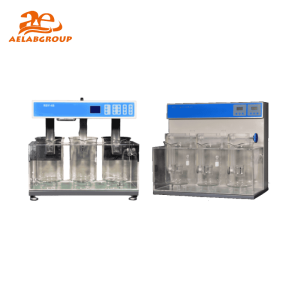
AELAB | Pharmaceutical Equipments | Thaw Tester
A Thaw Tester is essential freeze thaw testing equipment for monitoring thaw stability across food, pharmaceutical, and cosmetic products. By simulating controlled freeze–thaw cycles, a thaw tester reveals texture, separation, and potency shifts before products reach customers.
A thaw tester is a programmable laboratory instrument that exposes samples to alternating low and ambient/high temperatures to mimic real-world freeze–thaw conditions. It helps evaluate physical, chemical, and mechanical changes—such as phase separation, crystallization, moisture migration, texture shifts, or active ingredient degradation—supporting shelf-life prediction, quality assurance, and regulatory compliance.
| Feature | Details |
|---|---|
| Programmable Temperature Range | Typically from −30 °C to +60 °C |
| Cycle Customization | Set number of cycles, ramp rate, hold time, and dwell temperatures |
| Chamber Volume | Bench-top to large industrial sizes for higher throughput |
| Data Logging | Real-time temperature tracking and reporting; exportable logs |
| Sample Holders | Trays/racks adaptable to vials, tubs, jars, pouches, or plates |
| User Interface | Intuitive touchscreen; optional remote access/monitoring |
| Compliance Support | Facilitates FDA/ICH/ISO stability documentation and GLP-friendly records |
| Alarms & Safety | Alerts for temperature deviation, door status, and cycle completion |
| Aspect | Thaw Tester | Environmental Chamber |
|---|---|---|
| Primary Use | Focused on freeze–thaw cycles and recovery behavior | Broad temperature/humidity aging and stability |
| Cycle Speed | Fast, repeated transitions for rapid screening | Typically slower, long-term exposures |
| Control Precision | Specialized thaw recovery control and logging | General-purpose control across wider conditions |
| Best For | Freeze-thaw durability and formulation robustness | Shelf-life studies and environmental conditioning |
| Throughput | Optimized racks for multiple replicates | Varies; often larger internal volumes |
Q: What temperature range should a thaw tester cover?
A: Many applications are served by a programmable range of about −30 °C to +60 °C; choose wider ranges if your product experiences more extreme conditions.
Q: How many freeze–thaw cycles are typically run?
A: It depends on your protocol and risk level; labs commonly run from a few cycles for screening to dozens for robustness and shelf-life studies.
Q: How does a thaw tester differ from an environmental chamber?
A: Thaw testers specialize in rapid, repeated freeze–thaw transitions and recovery control, while environmental chambers are general-purpose systems for long-term temperature/humidity aging.
Q: What measurements should I record after each cycle?
A: Document visual changes (phase separation, syneresis), mass/volume loss, texture/viscosity, pH, and any potency or assay results relevant to your product.
Q: Which industries benefit most from thaw testing?
A: Food and beverage, pharmaceuticals (including vaccines and thermosensitive drugs), and cosmetics & skincare—especially emulsions prone to separation.
Looking for specific lab equipment? Fill out the form below, and our team will get back to you with detailed information and a personalized quote.